


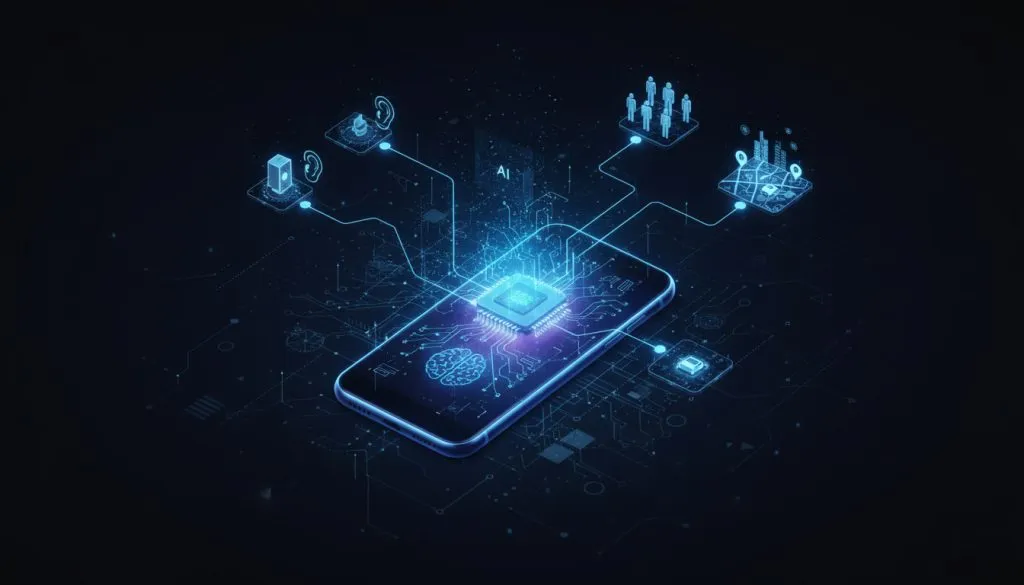
Introduction: Beyond Communication
For years, the smartphone has been the centerpiece of our digital lives. We use it to communicate, browse, and entertain. However, a fundamental shift is occurring. The device is no longer just a window to the internet; it is evolving into a sophisticated personal AI hub. This transformation changes how we interact with technology, shifting from manual app-opening to predictive, context-aware assistance.
The core insight of this evolution is the move from cloud-dependent processing to on-device intelligence. As processors become more powerful, complex AI tasks that once required a remote server can now be handled locally. This reduces latency, enhances privacy, and makes the user experience more seamless.
Why This Matters to Everyday Users
For the average user, this shift promises a digital companion that understands context. Imagine your phone knowing not just what you are doing, but why you are doing it.
- Privacy: On-device processing means sensitive data—photos, texts, location—stays on your phone rather than being sent to a server.
- Efficiency: Tasks like translation, photo editing, and voice recognition happen instantly without an internet connection.
- Convenience: Your phone anticipates needs. It might suggest leaving for an appointment based on traffic, or auto-suggest replies in a messaging app based on the conversation’s tone.
This technology is already present in flagship devices. Google’s Tensor and Apple’s A-series chips are designed specifically to handle these neural network tasks. The difference is becoming noticeable; interactions feel less robotic and more intuitive.
The Technology Powering the Shift: Neural Engines and NPUs
At the heart of this change are Neural Processing Units (NPUs). These are specialized silicon chips designed to run machine learning models efficiently. Unlike a standard CPU, an NPU can process millions of mathematical operations per second with minimal power consumption.
When you take a “portrait mode” photo, the NPU analyzes depth and subject separation in real time. When you dictate a message, it processes the audio locally to convert it to text. This hardware acceleration is the engine driving the software revolution. It allows for Edge AI—computing that happens at the edge of the network (on your phone) rather than in the cloud.
Visual Intelligence: Seeing is Understanding
One of the most visible applications of this technology is visual intelligence. Modern smartphones do not just capture pixels; they understand scenes.
When you point your camera at a menu in a foreign language, real-time text recognition overlays the translation instantly. When you scan a document, the software identifies the edges, corrects the perspective, and enhances the text readability.
Furthermore, photo libraries are becoming searchable databases. You can search for “dog” or “beach,” and the on-device AI retrieves the exact images without manual tagging. This capability extends to video, where AI can automatically generate highlights by recognizing key moments, faces, and action.
Voice and Language: The Conversational Interface
Voice assistants have been around for years, but they often felt clunky. The new generation of on-device AI makes voice interaction natural. Because processing is local, there is no awkward lag between speaking and the device responding.
Real-time translation is a game-changer. Two people speaking different languages can have a conversation through their phones, with translations appearing almost instantly. This breaks down barriers in travel and business.
Moreover, predictive typing is becoming smarter. It doesn’t just correct spelling; it suggests entire sentences based on the context of the conversation. This is made possible by Large Language Models (LLMs) running directly on the mobile hardware.
Augmented Reality (AR) and Spatial Awareness
Your phone is increasingly acting as a spatial sensor. Using LiDAR scanners (Light Detection and Ranging) and advanced cameras, phones map the physical world in 3D.
This enables immersive Augmented Reality experiences. You can virtually place furniture in your room to see how it fits before buying, or point your camera at a landmark to see historical data overlaid on the screen. This spatial computing requires immediate processing of depth and geometry, which is only possible with on-device AI.
The Privacy Implication of On-Device AI
As AI becomes more integrated into daily life, privacy concerns grow. The shift to on-device processing is a direct response to this. When data is processed locally, it doesn’t leave the device. There is no “data trail” sent to a cloud server for analysis.
This architecture is often referred to as Private AI. It ensures that personal details—biometric data, location history, private photos—remain under the user’s control. This is a critical development for users who are increasingly wary of how tech giants monetize their data.
The Future: The Autonomous Agent
The next phase of this evolution is the “autonomous agent.” Rather than simply reacting to commands, your phone will proactively manage your digital life.
Imagine a future where your phone:
- Screens calls using AI to determine if a call is urgent or a robocall.
- Manages notifications by summarizing them and only alerting you to high-priority items.
- Automates tasks like ordering groceries when supplies run low, based on usage patterns.
This is the ambient computing future—a world where technology fades into the background, assisting without demanding constant attention. The smartphone is the primary interface to this world.
Challenges and Considerations
Despite the advancements, challenges remain. Powerful AI processing requires significant battery life. Manufacturers are balancing performance with efficiency to ensure devices last all day.
There is also the “digital divide.” While flagship phones feature these advanced capabilities, older or budget devices may not have the hardware to run complex AI models. This could create a gap in user experience between high-end and entry-level devices.
Additionally, as AI gets better at mimicking human conversation and generating content, users must develop media literacy to distinguish between human-generated and AI-generated information.
Conclusion: The Personalized Future
The transformation of the smartphone into a personal AI hub is not a distant future—it is happening now. The device in your pocket is learning to understand your habits, your environment, and your intent.
For the user, this means a digital experience that is less about navigating menus and more about natural interaction. It is a shift from a tool you use to a partner that helps. As these technologies mature, the line between the physical and digital worlds will blur, making the smartphone the most powerful tool for personalization ever created.
The key takeaway for users is to stay informed about these capabilities. Understanding how to leverage on-device AI will unlock new levels of productivity, creativity, and privacy in the digital age.